After completing BAMS or BHMS, most doctors face the same question: what next? General practice is one path. But many AYUSH doctors are now looking toward dermatology and cosmetology — areas where patient demand is growing and where structured post-graduate training can genuinely add to clinical capability.
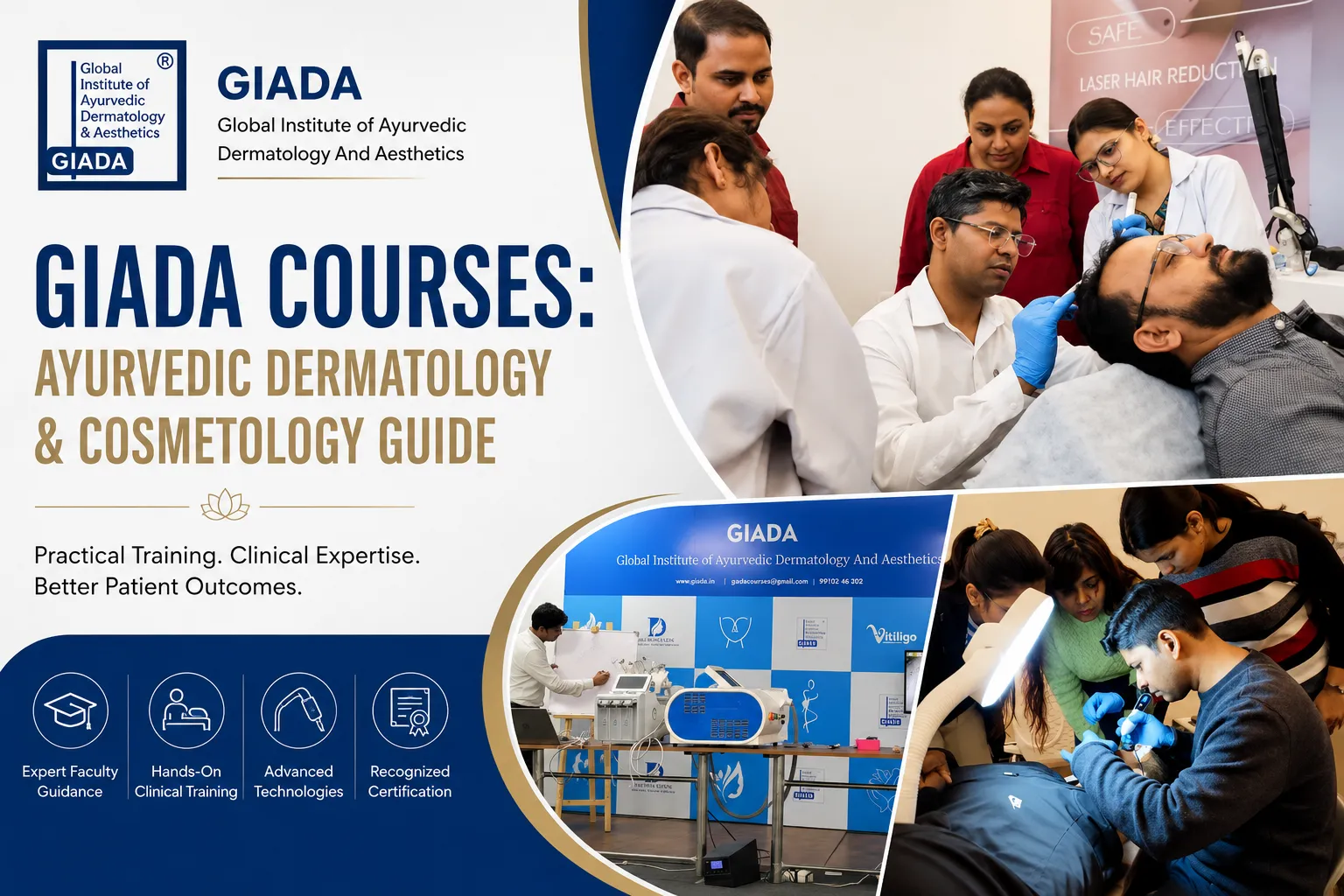
GIADA (Graduate Institute of Ayurvedic Dermatology and Aesthetics) is a Noida-based training institute that offers dermatology and cosmetology courses specifically for AYUSH doctors — BAMS, BHMS, BUMS, and BSMS graduates. The institute runs offline clinical training programmes, a structured internship, and online learning modules, all designed around the practical skill gaps that AYUSH graduates typically face when entering skin and aesthetic medicine.
This guide covers every major GIADA course, explains what each one involves, and helps you figure out which option makes sense for where you are right now.
Who Can Join GIADA Courses?
All GIADA courses are open to BAMS, BHMS, BUMS, and BSMS doctors. Final-year students and interns are also eligible for certain programmes. You do not need prior dermatology or cosmetology experience to join most courses — several are designed specifically for beginners.
Understanding Dermatology and Cosmetology
These two terms are often used interchangeably, but they are different in scope.
Dermatology is the medical management of skin diseases — conditions like eczema, psoriasis, fungal infections, vitiligo, and skin cancers. It involves diagnosis, investigation, and treatment of pathological skin conditions.
Cosmetology focuses on aesthetic improvement — procedures that address concerns like acne scars, pigmentation, hair thinning, skin ageing, and unwanted hair. It does not typically involve treating disease in the traditional sense, but it requires solid skin science knowledge and procedural competence.
In clinical practice the two areas overlap significantly, especially around conditions like acne and melasma. But a cosmetology course and a dermatology course have different learning objectives, and understanding this difference helps you choose the right programme.
Why Structured Clinical Learning Matters
This is worth saying clearly before going into course details. Learning to perform skin procedures from a book or a one-day demonstration is not the same as learning in a supervised clinical environment.
Procedures like chemical peels, PRP injections, and microneedling are performed directly on the skin. Done incorrectly, they cause visible, lasting harm — burns, pigmentation changes, scarring. Supervised training reduces this risk by giving you a chance to make and correct errors under guidance before you encounter them in independent practice. Any course you consider for cosmetology or dermatology should have real patient exposure and faculty supervision at its core.
Clinical Cosmetology Course
The Clinical Cosmetology Course is a 30-day offline hands-on training programme conducted at DTC Skin Clinic & Laser Center in Sector 44, Noida. It is open to all AYUSH doctors, including final-year interns, with no prior cosmetology experience required.
The programme is structured into ten modules. It begins with skin anatomy, Fitzpatrick skin typing, clinical photography, patient consultation, and treatment planning — the foundation that everything else builds on. Most short-term courses skip this entirely, which is precisely why many doctors who attend workshops still struggle to manage patients independently.
Procedural training covers a wide range across the subsequent modules:
- › Chemical peels — glycolic, salicylic, lactic, and mandelic formulations with protocol selection
- › Facial rejuvenation treatments including hydra facial, carbon facial, and medi facial
- › Microneedling and derma pen techniques for acne scars, open pores, and skin rejuvenation
- › PRP and GFC protocols for both facial applications and scalp hair treatments
- › Laser science with clinical applications including hair reduction and pigmentation management
- › Minor cosmetic procedures — wart removal, skin tag removal, corn removal, and benign lesion identification
The trichology module — covering hair anatomy, scalp disorders, androgenetic alopecia, and hair treatment planning — is often absent from shorter programmes. Similarly, the module on complication management addresses burns after peels, post-laser pigmentation changes, allergic reactions, and referral protocols, which are rarely covered in one-day certificate courses.
There is also a clinic setup and practice management module that addresses equipment selection, pricing, and digital presence for doctors planning to start their own practice.
Advanced injectables like botulinum toxin and dermal fillers are included for academic awareness and patient counseling purposes, with the explicit note that practitioners should follow applicable laws and professional council guidelines.
The course fee for the July 2026 batch is ₹55,000. Training is conducted in Hindi with English medical terminology, and study material and protocol templates are provided.
Best suited for: Fresh BAMS or BHMS graduates wanting comprehensive cosmetology training, or practicing doctors wanting a structured re-entry into aesthetic medicine.
CADC Course
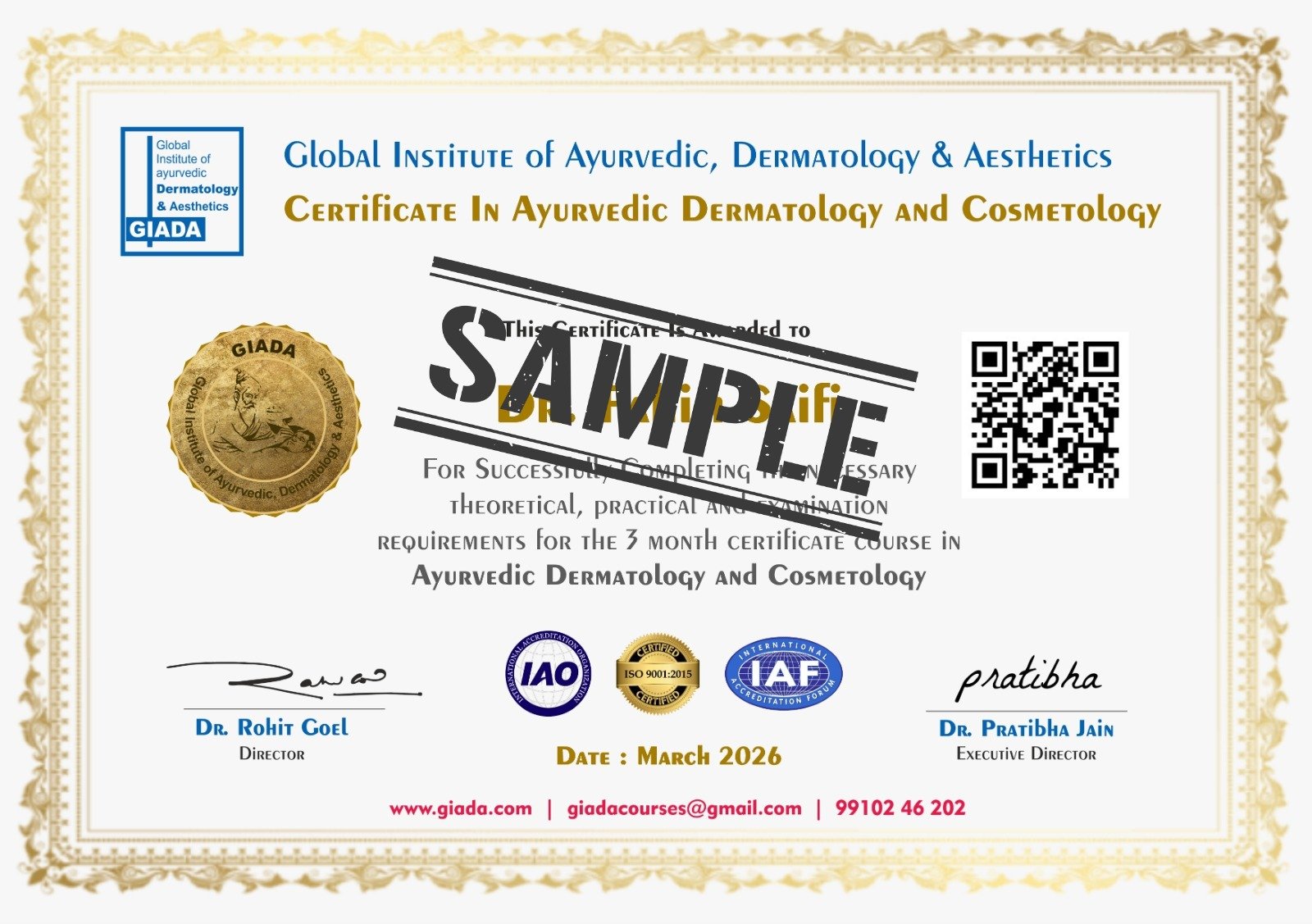
The CADC — Certificate in Ayurvedic Dermatology and Cosmetology is a different type of programme. Where the Clinical Cosmetology Course is entirely focused on aesthetic procedures, CADC combines Ayurvedic dermatology — the diagnosis and management of skin diseases — with cosmetology training. It is designed for doctors who want to build a broader skin practice, not just a cosmetic one.
CADC 3-Month Module
The three-month programme covers core Ayurvedic dermatology — understanding and managing common skin conditions from an AYUSH perspective — alongside an introduction to cosmetology procedures. For a fresh graduate entering the field of skin medicine, this module provides a clinical foundation that a cosmetology-only course does not.
CADC 9-Month Module
The CADC 9-Month Module includes an extended internship component alongside the core curriculum. More time in a clinical setting means more patient cases, more supervised procedures, and significantly more opportunity to build confidence. If you want to develop genuine competence in both dermatology and cosmetology, the nine-month format gives you the depth that shorter programmes cannot.
CADC Online Course
The CADC Online Course is available for doctors who cannot travel to Noida for offline training. It is a practical option for building theoretical knowledge — understanding conditions, terminology, treatment rationale, and clinical frameworks. Online learning cannot replicate hands-on procedural training, but it is a meaningful starting point for doctors in locations where offline training is not accessible, or for those who want to prepare before joining an offline programme.
Key difference: CADC is for doctors who want both dermatology and cosmetology. The Clinical Cosmetology Course is for those whose primary focus is aesthetic medicine.
One-Day Certificate Courses
GIADA offers six one-day certificate courses covering individual procedures. These are focused, single-topic workshops rather than comprehensive training programmes.
- › Acne & Acne Scar Management — covers acne grading, scar classification, and treatment options including chemical peels and microneedling combinations.
- › PRP Management — addresses PRP science, centrifuge handling, and clinical protocols for both hair and facial applications.
- › Chemical Peeling — covers peel types, patient selection, application protocols, and post-peel care.
- › Laser Procedures — introduces laser physics, tissue interaction, and clinical applications including hair reduction and pigmentation management.
- › Electric Cauterization — focused on electrocautery technique for minor skin lesions such as warts, skin tags, and milia.
- › Warts Management — covers wart identification, typing, and removal techniques.
These courses are most useful when you already have a clinical foundation and want to add a specific skill or update knowledge in one area. A doctor who has completed the Clinical Cosmetology Course or CADC and then attends a focused PRP or laser workshop will extract significantly more value from it than a doctor attending cold. Used in isolation, one-day courses give you familiarity with a procedure — they do not give you the clinical judgment to use it safely across different patient types.
Course Comparison Table
| Course | Duration | Mode | Main Focus | Practical Exposure | Best For |
|---|---|---|---|---|---|
| Clinical Cosmetology Course | 30 Days | Offline | Cosmetology & Aesthetic Medicine | Yes — Hands-on supervised | Fresh graduates & practicing doctors entering cosmetology |
| CADC 3-Month | 3 Months | Offline | Dermatology + Cosmetology | Yes — Clinical | Doctors wanting skin disease + cosmetic training |
| CADC 9-Month | 9 Months | Offline + Internship | Dermatology + Cosmetology | Yes — Extended clinical internship | Doctors wanting in-depth dermatology & cosmetology |
| CADC Online | Flexible | Online | Dermatology + Cosmetology Theory | Offline classes included | Doctors unable to attend offline, or pre-programme preparation |
| One-Day Certificate Courses | 1 Day each | Offline | Single procedure | Demonstration focused | Doctors adding one specific skill to an existing practice |
How to Choose the Right GIADA Course
Start by being honest about where you are right now.
If you are a fresh BAMS or BHMS graduate with no clinical cosmetology experience and your primary interest is aesthetic medicine — skin treatments, hair procedures, cosmetic interventions — the Clinical Cosmetology Course gives you a structured starting point with practical training.
If you are interested in managing skin diseases alongside cosmetic procedures, or if you see a long-term practice in Ayurvedic dermatology, the CADC programme is the more suitable option. The three-month format gives you the foundational curriculum. The nine-month format adds the internship depth that serious practitioners benefit from.
If you are a practicing doctor who already has some clinical exposure and wants to add one procedure to your current services, a one-day certificate course is a practical and time-efficient option.
If you genuinely cannot travel for training right now, the CADC online course gives you a way to begin building theoretical knowledge — with the understanding that offline practical training will still be necessary at some point.
The most important question to ask before joining any programme is not "which course looks most impressive" but "which course matches what I actually need to learn right now." A well-chosen three-month programme will serve you better than the longest available course if it does not match your goals.
Conclusion
GIADA offers a range of courses that address different stages of a doctor's learning journey — from a comprehensive 30-day cosmetology programme to a nine-month combined dermatology and cosmetology curriculum to focused one-day procedure workshops. Each serves a different purpose, and none of them is universally the "best" choice.
What matters is clarity about your goals, your current clinical experience, and how much time you can realistically commit to training. Take that honestly, match it against what each programme offers, and you will arrive at a decision that makes sense for your practice.